
Long before Indian cinema became associated with glamour, stardom, auditions and box-office success, simply working in a film was a major challenge. For women, that challenge was even greater.
In 1913, Indian cinema was still finding its feet. Dadasaheb Phalke’s Raja Harishchandra had been released that year and is widely regarded as India’s first full-length feature film. But while making it, Phalke faced a major problem—the lack of women willing to work as actors.
When he could not find a female performer for the role of Taramati, he eventually cast a man, Anna Salunke, in the part. At a time when acting was not considered a respectable profession, women entering the emerging film industry faced even greater social resistance.
But Dadasaheb Phalke was determined to change that.
His next film, Mohini Bhasmasur, would feature female performers. Around this time, a mother and her daughter were about to make their mark on the history of Indian cinema.
How Durgabai Kamat Began Her Film Journey
Around the same period, Raghunathrao Gokhale’s Chittakarshak Natak Company arrived in Nashik. Unlike many theatre groups of that era, the company had women performers.
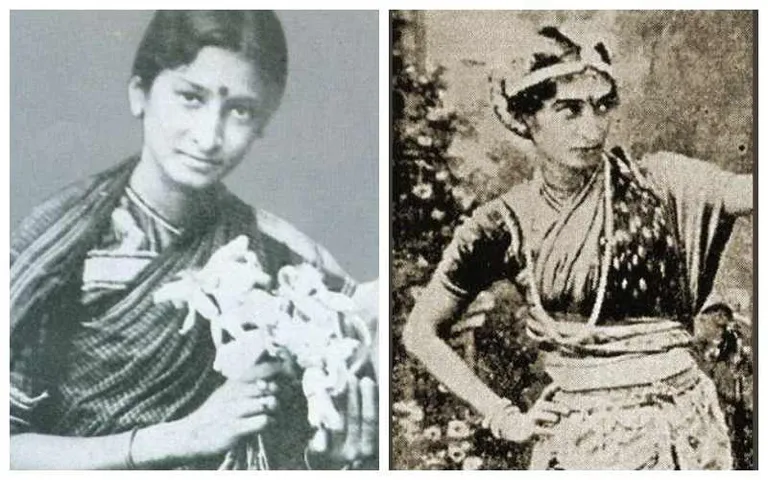
Among them were Durgabai Kamat and her daughter, Kamlabai Gokhale.
In filmmaker Reena Mohan’s 1992 documentary Kamlabai, Kamlabai shared several important memories about her mother. According to her recollections, Dadasaheb Phalke regularly attended the company’s performances.
When Phalke learned that the theatre company was going to shut down temporarily, he approached its owner, Raghunathrao Gokhale.
Phalke proposed that Durgabai and Kamlabai work in his film while the theatre company remained closed.
Raghunathrao agreed to the proposal.
Durgabai was cast as Parvati in Mohini Bhasmasur, while Kamlabai played Mohini. With this, Durgabai Kamat became one of the earliest female performers in Indian cinema and is widely remembered as India’s first female film actor.
Today, the event may seem like a small footnote in film history. At the time, however, a woman stepping into cinema represented a challenge to deeply rooted social norms.
Why Was Acting So Difficult for Women at the Time?
The social environment of early 20th-century India was completely different from today. In many communities, women working outside the home was itself considered inappropriate. Performing on stage or appearing in films faced even greater opposition.
As a result, female characters in early films were often played by men.
The difficulty Phalke faced while looking for actors for Raja Harishchandra illustrates just how small the pool of people willing to work in the new film industry was. An old casting advertisement associated with Phalke reportedly sought not only actors but also workers such as carpenters, washermen, barbers and painters.
For women, entering the profession meant directly challenging established social conventions.
Durgabai’s decision, therefore, was much more than simply accepting a role in a film. She entered a profession that society was not yet ready to accept for women.
And she made that choice during one of the most difficult periods of her personal life.
The Decision to Leave an Abusive Marriage
Much of the most important information about Durgabai Kamat’s personal life comes from the memories of her daughter, Kamlabai Gokhale.
In her conversation with Reena Mohan, Kamlabai described her mother as an exceptionally talented artist. Durgabai had learned Kathak and could play instruments such as the veena, sitar and tabla. According to Kamlabai, this talent came from her father, who was a renowned musician.
Behind Durgabai’s artistic abilities, however, was a deeply troubled personal life.
Kamlabai recalled that her father was violent toward her mother and subjected her to severe physical abuse. Eventually, the situation became unbearable for Durgabai.
She decided to leave the marriage.
During this difficult period, Kamlabai’s grandmother also supported Durgabai. She reportedly offered her jewellery and a house to help her rebuild her life.
Durgabai then moved to Bombay with her daughter, where the two attempted to start their lives again independently.
For Durgabai, theatre was not merely a form of artistic expression. It also became a means of earning a living and achieving independence.
The essence of Kamlabai’s recollection can be summed up in one question: How else could the two of them have survived?
Choosing Art Despite Social Opposition
Working was not easy for Durgabai.
Women who performed in theatre often faced social criticism and stigma. For a woman who had already left an abusive marriage and was responsible for raising her daughter, entering the theatre world created another major challenge.
Yet Durgabai refused to step back.
According to her daughter’s recollections, Durgabai viewed art and culture as a better path than the limited options available to women in her circumstances.
The criticism continued, but Durgabai had a daughter to raise and a future to rebuild.
There was no modern support system, professional agency, career manager or organised entertainment industry waiting to provide opportunities.
She had to create her own path.
Durgabai Had Already Established Herself in Theatre
Durgabai Kamat did not enter the film industry without any prior experience. Before working with Dadasaheb Phalke, she was already an experienced stage performer.
According to Kamlabai, her mother performed in prose plays and appeared in adaptations of several famous Shakespearean works.
Her roles reportedly included characters from King Lear, Macbeth and Romeo and Juliet. She also played Sudeshna, the wife of King Virata, in Keechak Vadh.
Kamlabai remembered her mother as a talented and exceptionally beautiful performer.
But Durgabai’s real significance went beyond her appearance.
What made her a pioneer was her courage to work at a time when women were expected to remain within traditional domestic roles.
Women Also Faced Opposition in Theatre
Durgabai was not immediately welcomed into the theatre world either.
According to Kamlabai, when women were given opportunities to perform in the theatre company, some male actors threatened to leave.
Actor Vinayakrao Kanetkar is also remembered as one of those who opposed the inclusion of women.
However, company owner Raghunathrao Gokhale stood by his decision and supported the female performers.
That decision would prove significant in the years that followed.
Theatre gave Durgabai an opportunity to become financially independent. It also eventually provided her with the path that would lead into the history of Indian cinema.
The Historic Meeting With Dadasaheb Phalke
Kamlabai’s memories of meeting Dadasaheb Phalke offer an interesting glimpse into the early days of Indian filmmaking.
Around 1912–13, the theatre company was performing in Nashik, and Phalke regularly attended its plays.
When he learned that the company was going to close temporarily, he visited the family.
He asked how long the company would remain closed.
When he learned that the break could last several months, Phalke made his proposal.
He asked whether Durgabai and Kamlabai could work in his film until the theatre company resumed operations.
The family accepted the offer.
The mother and daughter then began preparing for Mohini Bhasmasur. Kamlabai played Mohini, while Durgabai appeared as Parvati. Dattopant Sathe played Shankar, and Vishnupant Sane portrayed Bhasmasur.
According to Kamlabai, the film took around six months to complete.
The film became an important milestone in Indian cinema because women appeared on screen at a time when female participation in filmmaking was still socially controversial.
A Legacy That Continued Across Generations
Durgabai’s entry into cinema was not just her own story.
Her daughter, Kamlabai Gokhale, went on to work in theatre and films for more than six decades.
The family’s acting tradition continued through her son, Chandrakant Gokhale, and later through actors such as Vikram Gokhale and Mohan Gokhale.
In this way, the decision of one woman struggling to rebuild her life eventually became the beginning of a remarkable multigenerational acting legacy.
Durgabai may not have entered cinema with dreams of becoming a star. For her, the decision appears to have been driven first by the need to secure a future for herself and her daughter.
Yet that decision had a profound impact on the future of Indian cinema.
The Woman Cinema Almost Forgot
Despite her historical importance, very little verified information about Durgabai Kamat’s life is available today.
Details about her birth, marriage and later years vary across different accounts. Some reports state that she was born in 1879 and died in 1997, although these dates are difficult to independently verify.
Still, her daughter’s recollections provide an important picture of the woman behind the historical milestone.
She was a woman who endured domestic violence.
She was a mother concerned about her daughter’s future.
She was an artist who refused to suppress her talent simply because society disapproved of women performing.
And she became a pioneer at a time when the Indian film industry itself was still in its infancy.
More Than Just the Story of India’s First Female Film Actor
Remembering Durgabai Kamat only as India’s first female film actor would not fully capture the significance of her journey.
Her struggle was about much more than acting.
While India was fighting for independence from British rule, Durgabai was also fighting a deeply personal battle for freedom.
It was the freedom to work, become financially independent, raise her daughter and decide her own future.
There was no established film industry waiting to welcome her.
There was no female film star before her to pave the way. There were no casting directors, agents or publicists to guide her career.
She had only her talent, her daughter, her experience in theatre and the courage to make a difficult choice.
And she chose to stand in front of the camera.
More than a century later, women in the Indian film industry continue to speak about equal opportunities, equal pay, creative freedom and the right to build careers on their own terms.
The issues may have changed, but the path for women in cinema did not create itself.
Someone had to open that door first.
Durgabai Kamat was one of the women who had the courage to do it.
Her journey from an abusive marriage to theatre and eventually to cinema was not simply the beginning of an actress’s career. It was a story of struggle, independence, courage and survival.
And Durgabai Kamat’s chapter in the history of Indian cinema deserves to be remembered.