
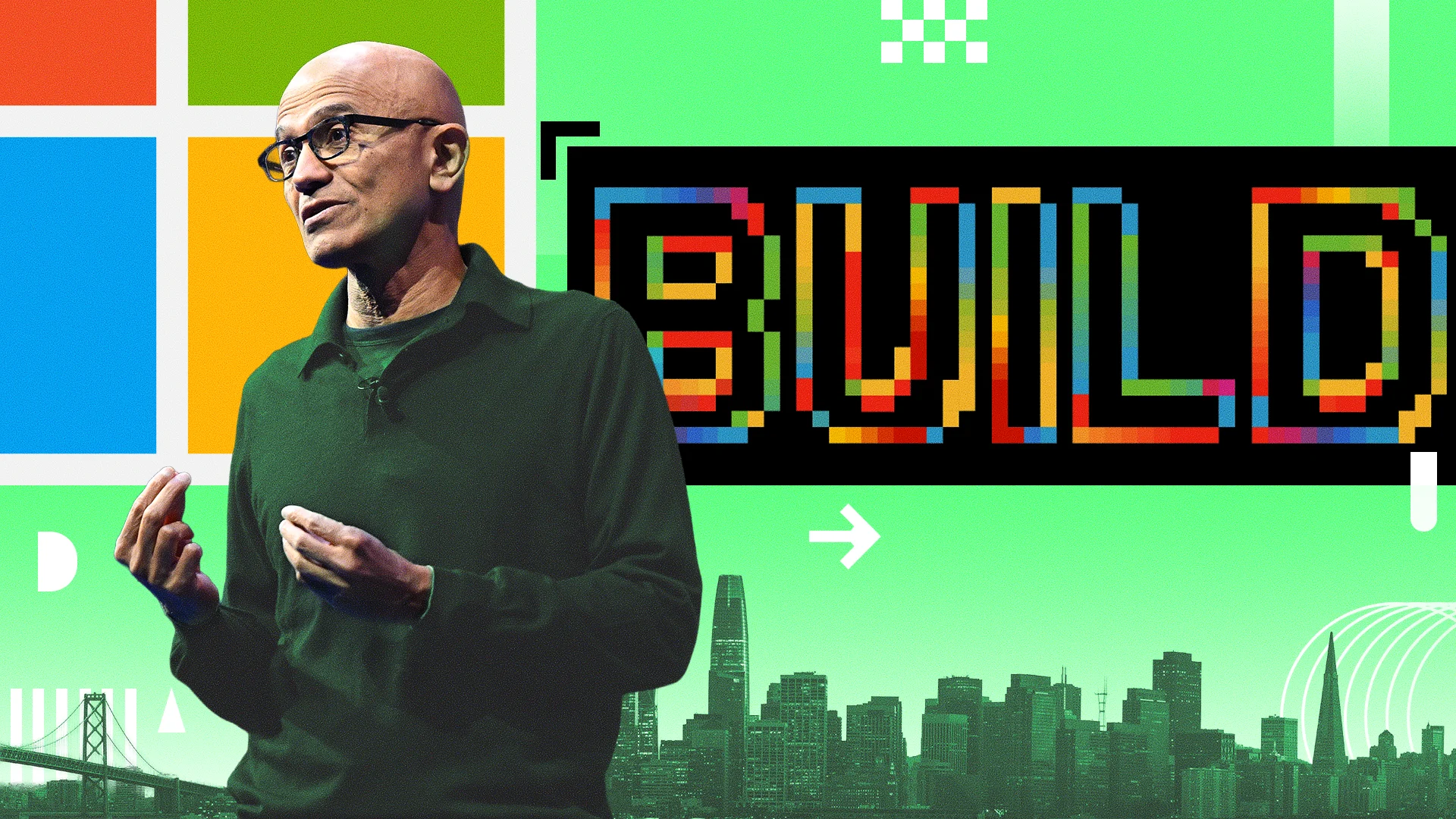
At its Build 2026 developer conference, Microsoft unveiled an ambitious roadmap for the future of artificial intelligence. During the annual event in San Francisco, CEO Satya Nadella highlighted AI agents, proprietary AI models, and next-generation computing platforms as key pillars of the company’s strategy. Microsoft is now moving aggressively to strengthen its position against major competitors such as OpenAI, Google, and Anthropic.
Although Microsoft has long been a leader in software and cloud services, it has historically relied on external partners for access to cutting-edge AI models. Build 2026 signaled a major strategic shift, with the company showcasing a range of homegrown AI technologies designed to reduce that dependence and give Microsoft greater control over its rapidly expanding AI ecosystem.
Microsoft Unveils Its First Reasoning AI Model
One of the headline announcements at the conference was MAI-Code-1-Flash, Microsoft’s first reasoning AI model built specifically for code generation. The model can convert natural language instructions into functional source code for websites, applications, and software projects.
MAI-Code-1-Flash is part of the company’s new MAI-Thinking-1 family. According to Microsoft, the model features 35 billion active parameters and a 128K context window. It has been designed to deliver strong performance, improved efficiency, and lower token costs, making advanced AI capabilities more accessible to developers.
Initially, MAI-Thinking-1 will be available through Microsoft Foundry as a private preview.
In addition to coding-focused models, Microsoft also introduced several proprietary AI systems for image generation, audio transcription, synthetic voice creation, and other multimodal applications.
Project Soltera: A New Platform for AI Agents
Microsoft also introduced Project Soltera, an Android-based platform developed specifically for AI agents.
The company describes Soltera as a “chip-to-cloud” ecosystem built for a future where multiple AI agents can work together seamlessly. Its goal is to power a new generation of business devices where AI agents serve as the primary user interface.
During the demonstration, Microsoft showcased a badge-like wearable device equipped with Wi-Fi, Bluetooth, wireless connectivity, a touchscreen display, and a fingerprint scanner. The company also presented a compact desktop unit featuring a built-in display.
These concepts are designed to illustrate how AI agents could eventually replace traditional software interfaces in workplace environments.
Scout: Microsoft’s New AI Assistant
Another major announcement at Build 2026 was Scout, Microsoft’s latest AI-powered assistant.
Built on the open-source OpenClaw platform, Scout is designed to help users prepare for meetings, manage calendars, draft emails, and handle various productivity-related tasks. The assistant is currently being tested with a limited group of customers.
Scout represents Microsoft’s entry into the rapidly growing autonomous AI agent category and is being positioned as a competitor to Google’s Gemini-based AI agent experiences.
Major Progress in Quantum Computing
Artificial intelligence was not the only focus at Build 2026. Microsoft also showcased its latest topological quantum computing chip, Majorana 2.
According to the company, Majorana 2 is approximately 1,000 times more reliable than its predecessor. Microsoft says the chip significantly improves qubit stability, potentially paving the way for commercially viable quantum computers capable of solving complex scientific and business challenges.
The company believes these advancements could accelerate the development of practical quantum computing solutions within the next few years.
Microsoft’s Push to Control the Entire AI Stack
The announcements made at Build 2026 demonstrate that Microsoft’s ambitions extend far beyond AI models alone. The company is actively investing across the entire AI stack, including AI models, cloud infrastructure, operating platforms, AI agents, and quantum computing technologies.
By developing and deploying its own AI models on Azure, Microsoft aims to reduce costs, improve efficiency, and lessen its dependence on external technology providers. This approach closely resembles Google’s strategy with its Gemini ecosystem.
The AI race is no longer just about building better chatbots or larger language models. Increasingly, it is becoming a competition to control every layer of the AI stack—from chips and operating systems to models, cloud infrastructure, and end-user applications.
Recent developments across the industry reflect this trend. Nvidia’s AI-focused processors, Google’s expanding Gemini platform, and Microsoft’s growing portfolio of proprietary AI technologies all suggest that the next phase of competition will be fought across the entire AI ecosystem.
With its announcements at Build 2026, Microsoft has made it clear that it intends not just to participate in the next wave of AI innovation, but to play a leading role in shaping it.