
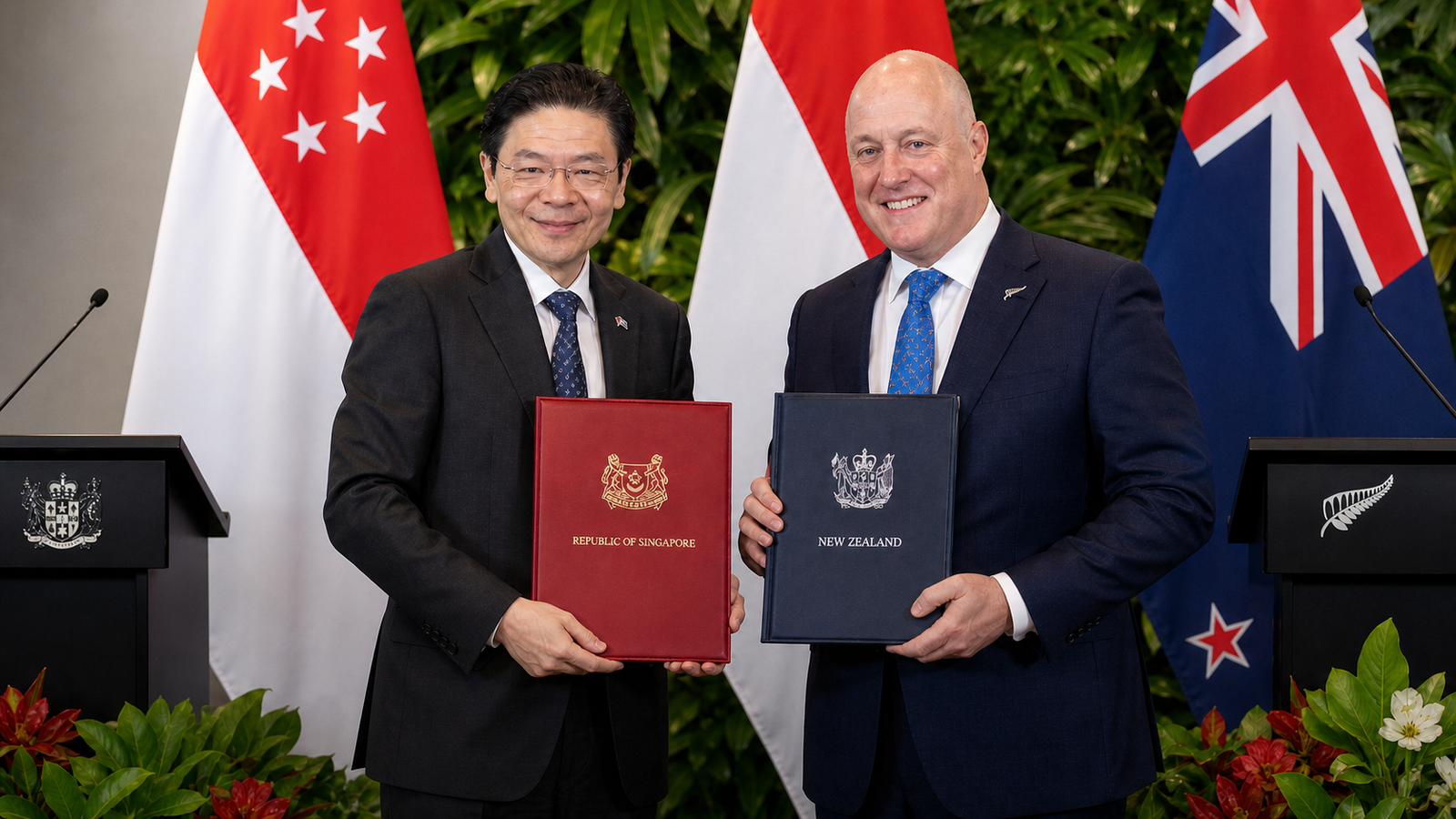
Global First Pact Ensures Regional Stability
In an unprecedented move that highlights the increasing interdependence of international business operations and rising geopolitical tensions, Historic Supply Chain Deal Signed Between Singapore and New Zealand to Ensure Availability of Vital Goods in Times of Crisis The ground-breaking agreement, made public on Monday during a state visit by New Zealand Prime Minister Christopher Luxon to Singapore, is a critical move towards achieving supply chain resilience in an increasingly unpredictable world.
Read More : Arrest of Chinese Captain of Russia-linked ‘Shadow Fleet’ Oil Tanker by Sweden
The Agreement: An Innovative Model
The Agreement on Trade in Essential Goods has been formally signed between Singapore’s Minister-in-charge of Energy, Science, and Technology, Tan See Leng, and New Zealand’s Minister for Trade and Investment, Todd McClay, at the Singapore-New Zealand Annual Leaders’ Meeting held in Singapore, in the presence of the respective prime ministers of both nations.
What stands out about this agreement is its comprehensiveness and its binding legal character. The two nations have pledged not to place undue export restrictions on the specified essential goods, which include food, fuel, healthcare goods, and chemicals and construction materials. This pledge is beyond the purview of traditional trade agreements, and it sets up a system where the movement of essential goods is ensured despite any potential disruptions.
The words of Singapore’s Prime Minister, Lawrence Wong, perfectly describe the atmosphere of this remarkable deal. He noted: “Despite any crises or shortages, the two countries will ensure the uninterrupted flow of goods — from food to fuel and other vital products. We will not lock out each other.” They clearly speak of a new paradigm when it comes to the obligations of two nations to each other in the era of extraordinary supply chain issues.
Mitigation of Risks Associated With Global Supply Chain
One should not underestimate the significance of such a partnership for both countries. The time for the agreement is rather appropriate, since they want to protect their trade-based economies from being impacted by the situation in Iran. Geopolitical tensions in the Middle East region have brought serious risks to global trade and maritime passages which transport millions of tons of goods on a daily basis. Thus, any closure of key straits such as the Strait of Hormuz has brought about a huge impact on the supply chain around the globe.
For countries like Singapore and New Zealand, which are highly dependent on trade, having consistent access to necessities is not just about efficiency; it is about national security and the welfare of their citizenry. For example, Singapore, being a major international trading country with few natural resources, is wholly dependent on imports for its requirements regarding energy, food, and other necessities. Similarly, New Zealand, despite having better agricultural self-reliance, is dependent on regular imports of energy, medicines, and goods.
Scope and Implementation
The trade agreement includes an obligation on both parties not to impose any restrictions on exports of necessities such as food, fuel, healthcare, chemical and building materials.
In addition to the basic promise of continuing the flow of trade, there is an elaborate institutional structure in place. An arrangement is made where both countries have ways in which they can help move goods around and share information in the event of a disruption in the supply chain, thus providing greater assurance to companies and their customers.
This structure plays a very important role, especially because of the lack of transparency and predictability that has been a characteristic feature of global supply chains in recent times. Both the countries now have structured communication systems that allow for the coordinated exchange of information on vital supplies even in times of disruptions to the supply chain.
The Strategic Alliance that Goes Beyond Trade
Whereas the above alliance is the main news in this agreement, it is important to view it against the broader background of the relationship between Singapore and New Zealand. As stated before, the two countries had outlined their intentions of deepening their economic collaboration through a strategic partnership agreement signed in October, which would involve among other issues the possibility of establishing a green economy partnership combining trade and environmental concerns, as well as investment and capital market cooperation.
Additionally, the two countries are also broadening their cooperation beyond trade issues and into issues of defense and security. It is clear from the statements made by the two governments that they intend to extend their partnership to include emerging defense cooperation issues such as unmanned vehicles.
Implications on the Larger Regional Context
However, it is important to consider the implications of such an agreement in a regional context that goes beyond the bilateral relationship between the two nations. At present, countries around the world, particularly in Asia, have been coordinating their efforts in order to reduce the effects of the supply disruptions that arise from the closure of the Strait of Hormuz.
In his remarks, Prime Minister Wong said that it might be that there will be constraints on the energy supplies through the Strait of Hormuz until the end of the year. Such a situation makes it clear why it is not enough to make plans but also to implement agreements and partnerships that will secure the energy supplies of these nations.
A Brighter Future Ahead
The agreement will come into force following the completion of domestic processes on both sides and will be included in the already existing free trade agreement between the two countries. Integration of the agreement into the already existing free trade agreement implies that the agreement will gain institutional support and become an integral part of the Singapore-New Zealand trade relations.
As global supply chains become more prone to risks caused by geopolitical conflicts, climate change, or other factors, such an agreement serves as a role model of how nations may collaborate to protect themselves from possible risks. The commitment to deliver supplies no matter what situation the two countries experience becomes a message saying that, in a globally interdependent world, the security of one nation equals the security of the whole planet.
The agreement itself is not only an economic bargain but a show of trust and acknowledgment of vulnerability and a practical step toward prioritizing the needs of people over economics. With the world getting more and more uncertain with every day that passes, this could prove to be the best possible investment for either party in the future.